Pular para o conteúdo
A+ Questões de Inglês
← Todas as questões

Tirinha Calvin and Hobbes: um homem de poucas palavras (Unifesp 2026)
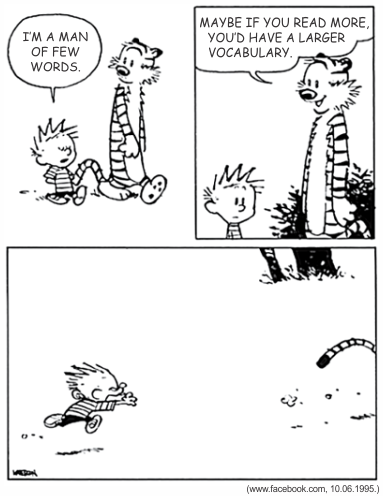
Tirinha em preto e branco de Calvin and Hobbes com três quadros. No primeiro, Calvin caminha ao lado do tigre Hobbes e declara, orgulhoso: 'I'm a man of few words.' (Eu sou um homem de poucas palavras.). No segundo, Hobbes retruca: 'Maybe if you read more, you'd have a larger vocabulary.' (Talvez, se você lesse mais, tivesse um vocabulário maior.), enquanto Calvin faz cara de contrariado. No último quadro, maior e sem falas, Calvin corre furioso atrás de Hobbes em um campo aberto — só se vê a cauda do tigre fugindo pelo canto direito. Assinatura de Watterson no desenho e crédito '(www.facebook.com, 10.06.1995.)'.

Fonte: Calvin and Hobbes, Bill Watterson.

Examine a tirinha Calvin and Hobbes de Bill Watterson. In the last panel, based on the cartoon, the boy got angry because

  1. A) he believed that he was wise but the tiger undermined his self-perception.
  2. B) the tiger said it had the same problem but, in fact, it was not true.
  3. C) the tiger agreed that he was a thoughtful boy.
  4. D) the tiger agreed with his statement that he was not talkative.
  5. E) he intended to annoy the tiger but the feline became happy with the result.
Ver gabarito comentado

Resposta correta: A

Calvin apresenta ser 'a man of few words' (um homem de poucas palavras) como uma virtude, sinal de sabedoria e profundidade. Hobbes desmonta essa autoimagem ao sugerir outra explicação: 'Maybe if you read more, you'd have a larger vocabulary' (talvez, se você lesse mais, tivesse um vocabulário maior) — ou seja, Calvin fala pouco por falta de vocabulário, não por sabedoria. Por isso, no último quadro, o menino persegue o tigre furioso: sua autopercepção foi minada, confirmando a alternativa A. A alternativa D falha porque Hobbes não concordou com Calvin; ele o contradisse com ironia.

Questões relacionadas

Ver todas →